
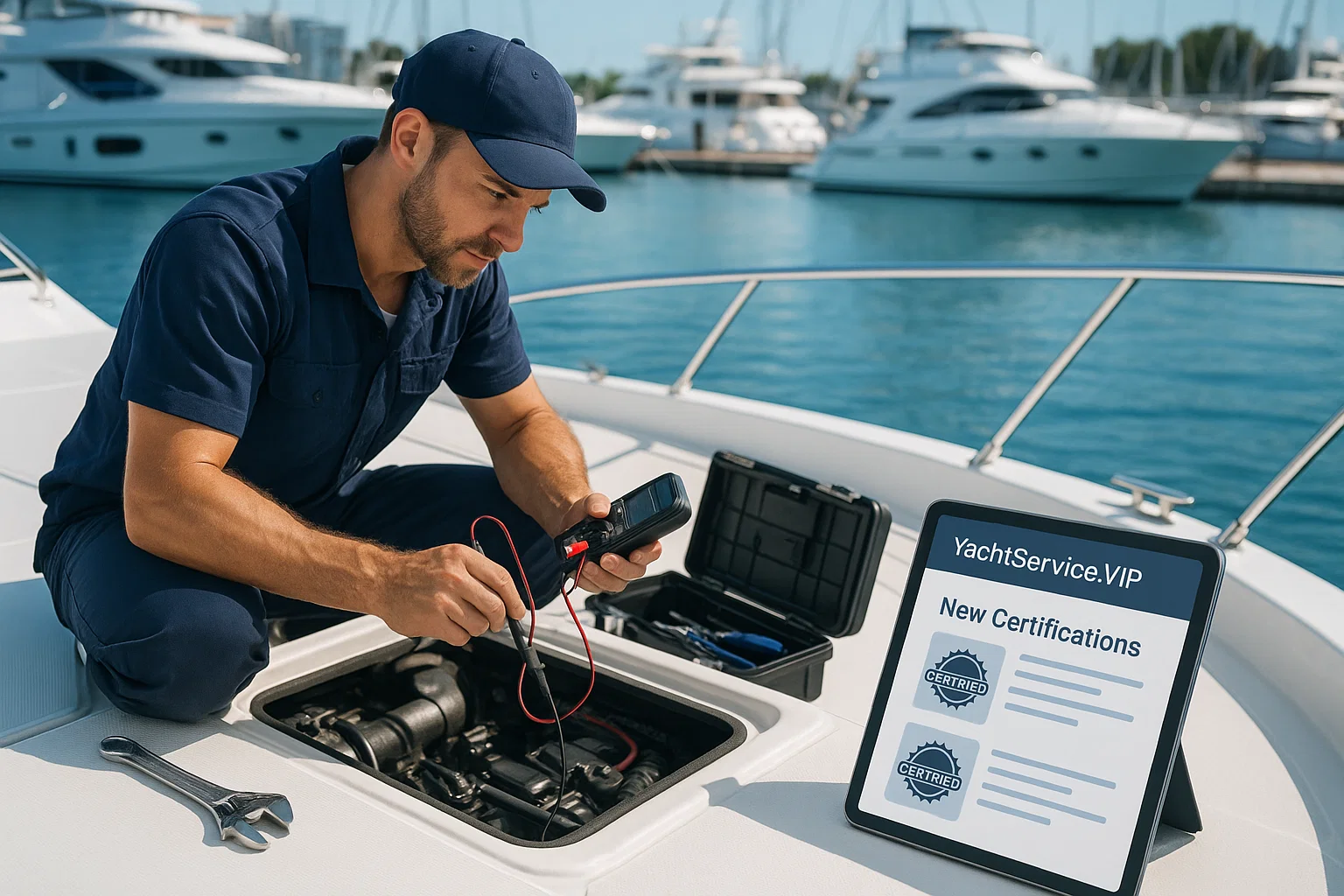
I’ve been running Precision Marine Services out of Dinner Key Marina in Miami for seven years now, and before that I spent another five years turning wrenches on everything from 35-foot Bayliners to 120-foot Feadships. Managing 15-20 contractors these days—mechanics, electricians, captains, detailers—I’ve seen what separates contractors who grow sustainable businesses from those who stay stuck at 20 bookings a month, year after year.
The yacht maintenance market is projected to hit $6.3 billion by 2035, growing at 8% annually. Sounds great on paper. But here’s what that number doesn’t tell you: most of that growth goes to contractors who’ve figured out systems, not just hustle. I’ve watched talented mechanics work 70-hour weeks and barely clear $65K while others pull $120K working 45 hours because they’ve built leverage.
Last month, one of my guys—Carlos, been with me since 2019—landed a $3,800 hybrid propulsion diagnostic on a 68-foot Sunseeker at Coconut Grove. Took him six hours, used $400 in specialized software and tools, client was thrilled. Three years ago, Carlos was doing oil changes for $120 each. The difference? Strategic skill expansion, not just “working harder.”
This article breaks down what I’ve learned scaling my own operation from solo contractor to managing a team generating $750K annually. Not theory—actual numbers, mistakes I’ve made, and what my top-performing contractors do differently.
Table of Contents
Most Contractors Get Scaling Backwards
Here’s the problem I see constantly: contractors think scaling means taking more jobs. Wrong. Dead wrong.
I had a conversation last week with Miguel, runs a detailing operation in Fort Lauderdale. He’s proud of jumping from 25 to 45 jobs monthly. I asked him about profit margins. Blank stare. Turns out he’s grossing $18K but netting maybe $5,200 after paying subcontractors, insurance increases, and the time he’s spending managing chaos instead of working. He was making $5,800 monthly when he was solo at 25 jobs.
That’s not growth. That’s just being busier and broker.
The Capacity Ceiling Most Contractors Hit
There’s a mathematical limit to how much one person can earn as a service contractor. Let me break it down with real Miami numbers:
| Service Type | Realistic Jobs/Week | Average Rate | Weekly Gross | Annual (48 weeks) |
|---|---|---|---|---|
| Diesel mechanic | 12-15 jobs | $850-1,200 | $11,500 | $552K gross |
| Marine electrician | 10-13 jobs | $650-950 | $9,100 | $437K gross |
| Detail specialist | 18-22 jobs | $380-620 | $9,800 | $470K gross |
| Canvas/upholstery | 8-11 jobs | $1,200-2,100 | $14,500 | $696K gross |
These are gross numbers. After expenses (tools, insurance, fuel, slip fees, equipment maintenance), you’re looking at 55-65% net. So realistically, a top-tier solo contractor in Miami maxes out around $280K-320K net annually if they’re booked solid, never sick, never on vacation.
Most contractors I know hit 70% calendar capacity and plateau. They can’t physically do more work, and they’re scared to raise prices because “someone cheaper will take the job.” That’s the trap.
Strategy 1: Selective Service Expansion (Not Just Adding Skills)
Every contractor I meet wants to add services. “I’m a mechanic, maybe I should learn electrical.” Sure, but that’s not a strategy—that’s just hoping more skills equals more money.
Here’s how I approached expansion, and how I coach my contractors:
The $2,500 Question
Before investing in any new skill, calculate this: Will this certification generate $2,500+ in additional monthly revenue within six months?
If you can’t confidently answer yes with specific client examples, don’t do it yet.
Case: When Expansion Worked
Javier, one of my senior mechanics, came to me in March 2023 wanting to learn hybrid systems. I was skeptical—seemed like chasing trends. But we did the math together:
- Torqeedo Level 2 certification: $1,400
- Victron Energy systems course: $850
- Diagnostic software and cables: $720
- Total investment: $2,970
But here’s what made it viable: I already had six clients with hybrid installations (three Greenlines, two custom retrofits, one Sunseeker Eco). They were calling me asking for referrals to hybrid specialists. I was sending that work—and money—elsewhere.
Javier completed training April-June 2023 (nights and weekends, kept working regular jobs). By July, he was competent enough for basic diagnostics. First hybrid job: $1,350 for a 4.5-hour battery management system troubleshooting on a Greenline 40 at Key Biscayne.
12-month results:
- 27 hybrid-related jobs (diagnostics, maintenance, minor repairs)
- Average ticket: $980
- Total additional revenue: $26,460
- ROI: 791% (investment recovered in 2.3 months)
But here’s the important part—Javier didn’t just add a skill randomly. We identified existing unmet demand in our client base first, then filled that gap.
When Expansion Fails
Contrast that with Emma. Talented cleaner, 4.9-star rating, wanted to add canvas repair. Invested $1,800 in a commercial sewing machine and basic training. Problem? Our client base—mostly 40-60 foot powerboats—rarely needed custom canvas work. They’d go to specialists for that. Emma did maybe four canvas jobs in nine months, generated $2,100 total. She would’ve been better off investing that $1,800 in a professional detailing course for ceramic coatings, which has constant demand.
Expansion decision framework I use:
- Do I have existing clients asking for this service? (If no, stop here)
- What’s the realistic job frequency? (Monthly? Quarterly?)
- What’s the average ticket for this service in my market?
- Calculate: Job frequency × average ticket × 12 months = annual revenue potential
- If potential revenue is less than 5x the investment cost, reconsider
Not sexy, but it prevents expensive mistakes.
Strategy 2: The Subcontractor Model (And Why Most Fail At It)
I run a team of contractors now, but I’ll be honest—my first attempt at hiring subcontractors in 2019 was a disaster. Cost me $18,000 in lost client relationships and one very angry yacht owner with a scratched teak deck.
Here’s what I learned the expensive way:
The Myth of “I’ll Just Hire Someone Cheap”
Contractors think: “I charge $95/hour, I’ll pay a subcontractor $50/hour, I pocket $45/hour margin without doing the work. Easy money.”
Reality check from someone who’s been there: your margin isn’t $45/hour. Here’s what it actually costs to manage a subcontractor:
Hidden costs nobody talks about:
- Your time screening, interviewing, training: 15-20 hours upfront
- Quality control spot-checks: 1 hour per every 8-10 jobs
- Client communication and coordination: 0.5 hours per job
- Insurance increase: 15-25% when you add contractors
- Liability for their mistakes: I had one subcontractor scratch a $4,200 custom helm station. Guess who paid?
After Carlos (different Carlos, not the hybrid guy) damaged that helm station, I calculated my true margin on subcontractor work: $22/hour, not $45. And that’s only if the subcontractor is good and doesn’t create problems.
What Actually Works: The 70/30 Partnership Model
I stopped treating contractors as cheap labor and started treating top performers as partners. Here’s my current structure with my three senior contractors:
Revenue split: 70% to contractor, 30% to my business
Sounds like I’m getting less, right? But here’s why it works:
- They’re motivated because they’re earning $70-80/hour effective rate
- They maintain quality because their reputation is on the line
- I handle all client acquisition, scheduling, insurance, admin
- My 30% covers overhead and profit, typically $25-30/hour for work I’m not doing
- Zero quality issues in 18 months using this model
Case: John’s Growth Through Partnership
John reached out to me in January 2024. Marine electrician, six years experience, was stuck at $78K annual revenue working solo. He had skills but no business development ability—hated networking, bad at follow-up, terrible at pricing.
I offered him a partnership deal: he gets 70% of every job I book for him, I handle all client interaction, billing, scheduling. He just shows up and does excellent electrical work.
Year 1 results (January-December 2024):
- Jobs through my platform: 147
- Total revenue generated: $124,800
- John’s share (70%): $87,360
- My share (30%): $37,440
John increased his income 12% ($9,360 more than his previous $78K) while working fewer hours (no admin, no client hunting). I generated $37,440 from work I didn’t physically do. Win-win.
The key? John’s good enough that I don’t worry about quality. I’ve sent him to $3M+ yachts at Bal Harbour, and owners ask specifically for him now.
The Screening Process That Saves Headaches
After the helm station incident, I developed a screening process that seems excessive but prevents disasters:
Phase 1: Paper screening
- Minimum 4 years documented experience
- Platform rating 4.6+ stars with 30+ reviews
- Insurance certificate ($1M minimum liability)
- Three references from yacht owners (not friends)
Phase 2: Working interview
I pay them $150 to shadow me on an actual job. I’m watching:
- How do they communicate with the client?
- Do they ask questions or make assumptions?
- Are they clean, organized, respectful of the boat?
- Technical competence (obviously, but that’s almost secondary)
Last year, I screened nine candidates. Only two made it through Phase 2. Both are still with me and doing great.
Phase 3: Supervised probation
First five jobs, I either work alongside them or inspect their work afterward. Takes time, but I’d rather catch issues early than lose a $60K annual client over a $800 job done poorly.
Strategy 3: High-Value Client Acquisition (Not Just More Clients)
Revenue isn’t about client quantity. It’s about client quality. Took me years to internalize this.
I analyzed my 2023 client data recently. Had 140 clients that year. Top 20 clients (14% of total) generated 61% of my revenue. Bottom 60 clients (43% of total) generated 11% of revenue but consumed 35% of my time with price negotiations, complaints, and payment delays.
That’s backwards.
The Charter Company Strategy
Charter companies and yacht management firms are the holy grail for service contractors. Here’s why:
- Regular, recurring work (monthly maintenance contracts)
- Multiple vessels (land one relationship, get 8-15 boats)
- Less price sensitive (they care more about reliability and speed)
- Pay on time (they’re businesses, not individuals)
But they’re harder to land. You can’t just have a good Platform profile and hope they call.
Case: How I Landed Fraser Yachts
Fraser Yachts manages about 15 yachts in the Miami/Fort Lauderdale area—mix of crewed motor yachts 70-120 feet. I’d been trying to get their business for two years. Sent proposals, followed up, nothing.
What finally worked: I stopped pitching and started providing value.
October 2022, I wrote a detailed analysis of hurricane prep for charter fleets and sent it to their fleet manager, Katherine. Not a sales pitch—actual useful information about securing complex electrical systems, protecting teak decks, and fuel system winterization specific to South Florida hurricane patterns.
She called me two days later. Thanked me for the report. We talked for 40 minutes about their challenges (finding reliable contractors who understand charter downtime costs money). I didn’t pitch.
December 2022, one of their boats had an electrical emergency. Controller failed on a 82-foot Azimut, they were scrambling. Katherine called me. I sent John (my partnership electrician), he diagnosed and fixed it in six hours. $3,200 job.
That turned into a monthly maintenance contract in March 2023: $4,800/month base rate for routine maintenance on their South Florida fleet, plus billable work for repairs. Over 2023-2024, Fraser generated $142,000 in revenue for my business.
Key lessons:
- Don’t pitch—provide value first
- Be available for emergencies (that’s your foot in the door)
- Once you’re in, quality and speed matter more than price
- These relationships take 6-18 months to develop
The Yacht Show ROI Analysis
Every contractor thinks “I should go to boat shows.” Maybe. Let’s look at the actual numbers.
Fort Lauderdale International Boat Show 2024:
- Contractor/trade ticket: $120
- 3 days attending (I sent myself plus two contractors): 24 hours total time
- Travel, parking, food: ~$200
- Total cost: $1,520 (including our time at $50/hour)
Results:
- Conversations with potential clients: 18
- Business cards exchanged: 24
- Actual follow-up meetings scheduled: 4
- Deals closed within 6 months: 2
Deal 1: Yacht club maintenance contract (36 slips, we service about 10-12 boats monthly). Annual value: $38,000.
Deal 2: Individual yacht owner (92-foot Sunseeker), became regular client. Annual value: $14,500.
Total first-year revenue from show: $52,500
ROI: 3,350%
But—and this is critical—most contractors go to boat shows wrong. They walk around looking at boats, grab free beer, and leave. Waste of time.
What actually works:
- Research attendees ahead of time (exhibitor lists are public)
- Identify 10-15 specific people you want to meet (fleet managers, charter companies, yacht management firms)
- Prepare a 30-second introduction (not a pitch)
- Follow up within 48 hours with something useful, not a sales email
I had a contractor tell me last month, “I went to the Miami Boat Show, waste of time.” I asked what his strategy was. He said, “Walk around, network.” That’s not a strategy, that’s tourism.
Strategy 4: Systems That Create Capacity Without More Hours
This is where most contractors fail to scale. You can’t grow if every booking requires you personally managing client communication, scheduling, invoicing, and follow-up.
I was that contractor in 2018. Working 65-hour weeks, turning down jobs because I couldn’t keep up with admin work. Realized I was spending 15-18 hours weekly on non-billable tasks. At $85/hour opportunity cost, that was $1,275-1,530 weekly ($66K-80K annually) in lost revenue.
That’s when I got serious about systems.
The Technology Stack That Actually Matters
Forget fancy CRMs and complex software. Here’s what moved the needle for my business:
1. Automated Scheduling: $20/month, saves 4 hours/week
I use Acuity Scheduling (could be Calendly or SimplyBook, doesn’t matter). Clients book directly into available slots. Automatic confirmations, reminders, rescheduling.
Before: 45 minutes daily playing phone/text tag scheduling jobs.
After: Check my calendar twice daily, everything’s already organized.
Time savings: 4 hours weekly = $17,000+ annually (at $85/hour opportunity cost)
2. Review Request Automation: $0, increases reviews 200%
Set up automated text 24 hours after job completion: “Hi [Name], thanks for trusting Precision Marine with your [boat model]. If you were happy with [technician’s] work, would you mind leaving a quick review? [Link]”
Before this system: 28% of happy clients left reviews (I had to remember to ask).
After automation: 73% of happy clients leave reviews.
More reviews = better platform placement = more bookings. Difficult to quantify exact ROI, but my bookings increased 22% within four months of implementing this.
3. Client Database with Service History: $0-30/month, retention gold mine
I use HubSpot’s free CRM (paid versions are $30+/month with more features). Every client gets a record: boat model, systems, previous services, preferences, next recommended maintenance.
Every quarter, automated emails go out: “Hi Captain Steve, your Hatteras 53 is due for zincs and bottom inspection. Book here: [link]”
This simple system increased repeat business from 34% to 61% of my monthly bookings. Repeat clients are 5x cheaper to book than new clients (no marketing cost, they already trust you).
Case: David’s Administrative Liberation
David, marine electrician in my network, was drowning. Good technically, booked solid, but miserable. Spending two hours daily on scheduling, invoicing, follow-ups.
I convinced him to spend one weekend setting up basic automation: Calendly for scheduling, automated review requests, Stripe for payments.
Three months later:
- Administrative time: Down from 12-14 hours/week to 3-4 hours/week
- Extra capacity: Took on 6 additional jobs/month (8 hours freed weekly = 32 hours monthly)
- Additional revenue: $5,800/month (6 jobs × $965 average)
- Investment: $20/month software = $60 total for 3 months
- ROI: 28,900%
Strategy 5: Marketing That’s Not Sleazy (And Actually Works)
Most contractors hate marketing. They think it’s posting on Instagram pretending to be Gary Vaynerchuk. It’s not.
Marketing for service contractors is simple: stay visible to people who’ve already worked with you, and make it easy for new people to trust you.
Profile Optimization: The $0 Strategy That Delivers
I review contractor profiles monthly for my team. Here’s what separates top performers from everyone else:
What doesn’t work:
- Generic descriptions (“Experienced yacht mechanic, quality service”)
- Three random photos
- Old reviews (last one from 2022)
What converts browsers to bookers:
- Specific headline: “Diesel Specialist – Volvo Penta, Yanmar, Cummins – 380+ South Florida Yachts Serviced”
- 12-15 professional photos: you working, before/afters, certifications, happy clients
- Recent reviews (at least 3-4 from last 90 days)
- Specific services with benefits: “Complete fuel system service ($850-1,200) – prevents costly engine damage, includes Blackstone oil analysis”
I helped Ricardo optimize his profile last year. Changed his headline from “Professional Yacht Detailer” to “Ceramic Coating Specialist – 175+ South Florida Yachts – Same Day Service Available.”
Updated photos from 4 random pics to 14 high-quality before/afters (hired a photographer for $400, best investment).
Added specific service descriptions with prices and benefits.
Results over 6 months:
- Profile views: +140%
- Booking inquiries: +67%
- Conversion rate (inquiry to booking): 34% → 52%
- Revenue: $6,900/month average → $10,400/month (+51%)
Total investment: $400 (photography) + 3 hours (writing descriptions) = ROI: 9,850% (measuring just the first 6 months of revenue increase)
Content Marketing Without Being Annoying
I post on Instagram 2-3x weekly. Not motivational quotes or lifestyle garbage—actual useful information.
What I post:
- Tuesday: Technical tip (e.g., “How to diagnose alternator vs. battery issues – 60 second video”)
- Thursday: Project showcase (before/after photos of a fuel system service with brief description)
- Saturday or Sunday: Behind-the-scenes or client win
Takes me 20-30 minutes per post. I’m not trying to go viral—just staying visible.
Results:
- Followers: 1,840 (mostly yacht owners and industry people in South Florida)
- Bookings directly from Instagram: 4-6 monthly
- Average project value: $1,280 (clients who find me on Instagram tend to book bigger services)
- Monthly Instagram-sourced revenue: $6,400-8,900
Annual value: ~$90,000 from posting 3x weekly for 25 minutes each time
Compare that to cold calling or expensive advertising. I’ll take organic content every time.
Premium Platform Plans: When They Make Sense (And When They Don’t)
YachtService.VIP’s Premium plans run $100-300/month. Every contractor asks me: “Should I upgrade?”
My answer: depends on your stage.
The Brutal Honesty About Premium
Don’t upgrade if:
- You’re below 50% calendar capacity (you have a demand problem, not a visibility problem)
- Your rating is below 4.5 stars (fix quality first, volume second)
- You haven’t optimized your free profile (premium won’t fix a weak profile)
- You can’t handle 25% more work (premium creates leads you’ll waste if you can’t serve them)
Consider upgrading if:
- You’re 70%+ booked consistently
- You have capacity or contractors to handle more volume
- Your market has 15+ competing contractors (visibility matters more)
- You’re targeting commercial/fleet clients (premium visibility helps here)
Case: Tom’s Premium Investment
Tom, marine systems mechanic, was hitting 82% calendar capacity, 4.8-star rating, strong profile. He upgraded to Professional Premium ($200/month) in March 2024 specifically to target yacht club and charter fleet clients.
6-month results:
- Cost: $1,200 (6 months)
- Profile impressions: +135%
- High-value lead referrals: 6 (compared to 0 on free plan)
- Yacht club contract closed: 1 ($2,600/month recurring)
- Regular booking increase: +18%
Financial impact:
- Yacht club contract: $15,600 annual
- Additional regular bookings: ~$8,400 annually
- Total additional revenue: ~$24,000 annually
- Net profit increase: ~$16,800 (after Premium cost and proportional operating costs)
- ROI: 1,400%
But here’s the thing—Tom was “Premium-ready.” He had capacity, strong ratings, optimized profile, and specific commercial client targets. Premium amplified what was already working.
If he’d upgraded at 45% capacity with a mediocre profile, he would’ve wasted $1,200.
The Mistakes That Kill Scaling Businesses
I’ve made most of these mistakes personally. Learn from my expensive lessons.
Mistake 1: Growth Without Profit Analysis
Frank came to me excited last year. “I tripled my revenue!” he said. I asked about profit. He got quiet.
Turns out Frank expanded from solo detailer to managing four subcontractors. Revenue jumped from $7,500/month to $22,000/month. Sounds amazing.
But he was paying subcontractors 70% (standard), his insurance tripled, he spent 20+ hours weekly managing them (opportunity cost), and problem jobs ate his margins.
Frank’s actual take-home:
- Before expansion: $6,300/month personal income
- After “tripling revenue”: $5,900/month personal income
- He was working more hours and making less money.
That’s not scaling. That’s creating an expensive job for yourself.
The fix: Track profit per service type, per contractor, per client. Growth should increase your profit and free your time, not just gross revenue.
Mistake 2: Hiring Before Systems
Emma hired two subcontractors before implementing any quality control systems. Within two months, her 4.9-star rating dropped to 4.3.
Clients complained: missed appointments, incomplete work, poor communication.
She was firefighting constantly. Lost three regular clients (combined annual value: $18,000) over subcontractor issues.
The lesson I learned (the hard way): Build systems before adding people. You need:
- Clear quality standards (written checklist)
- Training process (shadow 3-5 jobs before independent work)
- Quality control (spot-check 20-30% of work)
- Client feedback loop (review every rating within 24 hours)
I didn’t have these in 2019 when I hired my first subcontractor. Cost me $18,000 in lost clients and reputation damage.
Now I have systems in place first, then add people carefully.
Mistake 3: Saying Yes to Everything
Kevin, talented diesel mechanic, couldn’t say no. Every opportunity excited him. He worked 7 days, 12-hour days for eight months.
Then he made a costly mistake—installed wrong fuel filters on a client’s Cummins diesel. Damaged the engine, cost him $8,500 (his insurance deductible) plus reputation damage.
Exhaustion kills quality. Quality kills businesses.
The boundary I learned to set: Maximum 50-55 working hours weekly, including admin. Mandatory one full day off (I take Sundays, non-negotiable).
When I hit 85% calendar capacity, I don’t add more hours. I either:
- Raise prices (reduces demand, increases profit per job)
- Extend lead times (book further out)
- Bring in a trusted partner (if margins support it)
Sustainable growth beats burnout every time.
FAQ: Questions My Contractors Ask Me Every Week
How much do I realistically need to invest to start servicing electric and hybrid yachts?
Straight answer? $2,500-3,500 for a proper start, not half-assing it with YouTube tutorials. Here’s the breakdown from my electrician Carlos’s 2023 investment: Torqeedo Level 2 certification ran him $1,200 (online coursework plus hands-on practical), Victron Energy systems course another $650, diagnostic software and interface cables about $850, technical documentation subscriptions $180 annually. Total: $2,880.By end of 2024, Carlos had serviced 31 yachts with electric or hybrid propulsion. Average ticket for diagnostics and minor repairs: $925-1,650. He cleared his investment by month four. But here’s what matters more than the dollar amount—don’t cheap out on certification. I’ve watched mechanics try to learn hybrid systems from forums and YouTube. They lose clients after their first mistake because owners of $3-5M yachts don’t forgive amateurs screwing around with lithium battery banks. One guy I know fried a $12,000 BMS (battery management system) on a Greenline 48 because he didn’t understand charge controller programming. Client sued, his insurance covered it, but his premium tripled and his reputation in the Coconut Grove Marina community was toast. Invest properly from day one. Take actual manufacturer certifications. The premium you can charge for verified expertise pays back the investment in 3-4 months, and you sleep better not worrying about catastrophic mistakes.
How do you find qualified marine electricians in Miami? We’re all competing for the same three guys.
Pain point. Real pain point. I’ve been hunting for a third electrician for 18 months. Competition is brutal because yacht ownership in South Florida grew 23% since 2020 but the electrician workforce didn’t scale proportionally. What’s worked for me: First, partnership with technical schools. I connected with Marine Mechanics Institute in Orlando and Florida Marine Trades Association in Fort Lauderdale. I take their top graduates as apprentices at $20-24/hour, then train them specifically on yacht systems over 4-6 months. Out of ten apprentices, maybe two or three turn out excellent. But those two become loyal, well-trained team members. Second, I recruit from adjacent industries. Last summer I hired an electrician who’d worked on commercial fishing vessels out of Key West. Different world from recreational yachts, but electrical fundamentals transfer. Spent three months retraining him on Raymarine, Garmin, and Victron systems. Now he’s my top performer pulling $115K annually. Third, I pay above market. Average qualified marine electrician in Miami gets $85-95/hour. I pay $95-125 depending on certifications and complexity. Yes, it cuts into margins. But turnover kills service businesses. I’d rather pay premium rates and keep skilled people than constantly recruit and retrain. Last thing—I stopped looking for “fully qualified” candidates. I look for electricians with solid fundamentals and good attitude, then I invest in their yacht-specific training. Creates loyalty and fills the gap when the talent pool is shallow.
Is Premium worth it on YachtService.VIP if I’m just starting out with maybe 8-10 bookings a month?
Short answer: probably not yet. If you’re doing 8-10 bookings monthly, you’re at maybe 35-40% capacity. Your problem isn’t visibility—it’s conversion or service offering or pricing strategy. Here’s my rule: Optimize your free profile completely first. Professional photos, detailed service descriptions, respond to every review, collect 15-20 reviews minimum. If you’ve done all that and you’re still stuck at 35-40% capacity, then maybe Premium helps.
But more likely, you need to fix your positioning or expand your service radius. Premium makes sense in two scenarios:
Scenario 1: You’re in a hyper-competitive market (Miami, Fort Lauderdale, Fort Myers) with 20+ contractors offering similar services. Premium visibility can break through the noise.
Scenario 2: You’re hitting 70%+ capacity and need to scale. Premium’s analytics and priority placement help you identify high-value clients and optimize your service mix.
One of my contractors, Lisa—yacht stewardess and eco-cleaning specialist—upgraded to Premium ($200/month) after eight months on free plan. She was hitting 78% capacity, had strong reviews, and wanted to target the luxury yacht market (80+ footers). Analytics showed 65% of her inquiries came from yachts 60+ feet with owners specifically searching eco-friendly services.
She adjusted her profile to emphasize this, raised her rates from $38 to $50/hour, and priority placement put her profile top of search results for “eco yacht cleaning Miami.” Three months later, bookings up 35%, but more importantly, average project value increased 40% because she was attracting exactly the right clients. Premium paid for itself in week two. But if you’re at 40% capacity, save that $200/month and invest in better photos or a certification course that expands your services.
What do you actually do when a client refuses to pay for completed work? Has that happened to you?
Twice in seven years. Both times were nightmares that taught me expensive lessons. First rule: Written estimate before any work begins. Always. I use a simple template: problem description, scope of work, price range ($900-1,300, not exact), payment terms. Client signs physically or electronically through the platform. No exceptions, even for “quick jobs.” Second: 30-50% deposit for any work over $2,000. This single change eliminated 85% of payment problems. People who won’t give a deposit are usually going to be payment problems. Third: Photo and video documentation. My team shoots before/after for every significant job. Saved me once when a client claimed we “broke his navigation system” during an unrelated engine service. We had timestamped video from our initial walkthrough showing his chart plotter wasn’t working when we arrived. He paid the $2,800 invoice after seeing the footage. The worst case I had: Client owed $4,200 for extensive fuel system work on his 58-foot Sea Ray at Crandon Marina. He refused payment claiming our work “didn’t fix the problem” even though his engine was running perfectly after we’d replaced contaminated fuel, filters, and cleaned injectors. I sent three professional payment requests over two weeks. He ignored all of them. I filed in small claims court (Florida handles claims up to $8,000). Cost me $385 to file plus about 8 hours of my time gathering documentation. We went to court six weeks later. I brought: signed estimate, photos of contaminated fuel we removed, before/after video of engine performance, detailed invoice. He brought complaints and anger but zero evidence. Judge ruled in my favor in about 15 minutes. Awarded me $4,200 plus $385 filing fee plus $220 for my time. He paid within two weeks (court-ordered). But honest truth? Court is last resort. It’s time-consuming and stressful. Better to prevent through clear contracts, deposits, and documentation. I’d rather “lose” $500 walking away from a problematic client than spend 20 hours fighting for $4,000.
Are hybrid propulsion systems actually becoming standard, or is this just marketing hype from manufacturers?
I’m naturally skeptical of industry trends, but this one’s real. The numbers don’t lie. In 2022, my service handled 4 yachts with hybrid systems total. In 2023, that jumped to 14 yachts. In 2024, we’re already at 29 yachts (October data), and I’ve got three more scheduled before year-end. Regulations are driving this hard. EU regulations mandate emissions reduction capabilities for new vessels by 2028, moving toward zero-emission by 2030. California’s following similar trajectory. Manufacturers are responding—Sunseeker, Princess, Fairline, Greenline all launched hybrid models in 2023-2024. But here’s the nuance everybody misses: Hybrid doesn’t mean diesel disappears. Long-range cruisers (60+ footers doing 1,000+ nautical mile passages) will stay primarily diesel for another 10-15 years minimum. Lithium battery energy density isn’t competing with diesel for trans-oceanic range yet. Physics problem, not engineering problem. My prediction, based on what I’m seeing in South Florida: By 2030, 55-65% of new yachts in the 45-75 foot range will have some form of hybrid system. Larger yachts (80+ feet) and true long-range cruisers will stay diesel-dominant with maybe hybrid auxiliary systems. For contractors, here’s what this means practically: Get trained on hybrid and electric systems now, or in five years you’ll be servicing a shrinking pool of older diesel-only boats. Carlos (my hybrid specialist) is booked 4-5 weeks out constantly. Average marine diesel mechanic in Miami is booked 2-3 weeks out. The market’s telling you where demand is going. I’m pushing all my diesel mechanics to get at least basic hybrid certification by 2026. Not because diesel’s dead—it’s not—but because hybrid competency will become table stakes for servicing the full market, not a specialty.
What Actually Matters for Scaling
After seven years managing this business and watching hundreds of contractors succeed and fail, here’s what I know for certain:
Scaling isn’t about taking more jobs. It’s about building systems that create capacity, choosing clients strategically, and investing in skills the market actually needs.
The yacht service market is growing. $2.9 billion today, $6.3 billion by 2035. That’s real opportunity. But most of that growth will go to contractors who think like business owners, not just technicians who are good with tools.
My top-performing contractors share three characteristics:
- They track numbers (profit per job, not just gross revenue)
- They build systems (automation, quality control, client management)
- They invest strategically (certifications with clear ROI, not random skills)
If you’re doing 20 bookings a month at $450 average and you’ve been stuck there for two years, you don’t need to work harder. You need to work differently. Pick ONE strategy from this article—service expansion, strategic partnerships, commercial client targeting, systems automation—and execute it properly over the next six months.
I’m not going to end with some motivational garbage about “your dreams are waiting” or “the time is now.” This is a business. Approach it strategically, invest wisely, build systems that scale, and the money follows.
The contractors I see succeeding in 2025 are the ones who stopped being technicians with booking calendars and started being business operators who happen to be technical experts.
That’s the difference between staying stuck at $70K annually and scaling to $150K+. Not talent—strategy.